Running a Destination Management Company (DMC) is operationally intense.
On any given day, your team may be:
- •Building custom itineraries
- •Recalculating pricing
- •Responding to email inquiries
- •Confirming availability with suppliers
- •Updating spreadsheets
- •Sending revised proposals
- •Following up on unpaid quotations
Most of this work is necessary. But a surprising amount of it is repetitive.
Over time, manual processes don't just slow you down — they limit growth.
If you're looking to reduce manual work in your DMC operations, the goal isn't to remove the human touch. It's to automate repetitive tasks so your team can focus on designing better experiences and closing more bookings.
Below are five practical ways DMCs can streamline operations without overcomplicating their systems.
1. Standardize and Reuse Multi-Day Itinerary Structures
One of the biggest time drains in inbound tour operator workflows is rebuilding itineraries from scratch.
Even when routes are similar — such as a 7-day Morocco circuit or a 10-day cultural program — teams often recreate:
- •Day structures
- •Inclusions
- •Descriptions
- •Pricing logic
This creates unnecessary repetition.
Practical Tip
Create structured tour templates for your most frequently sold programs:
- •Pre-defined day breakdowns
- •Standard activities
- •Default inclusions/exclusions
- •Linked suppliers
- •Base pricing models
Instead of starting from zero, your team duplicates and adjusts.
This approach can reduce itinerary creation time by 40–60%, especially for FIT bookings that require minor customization.
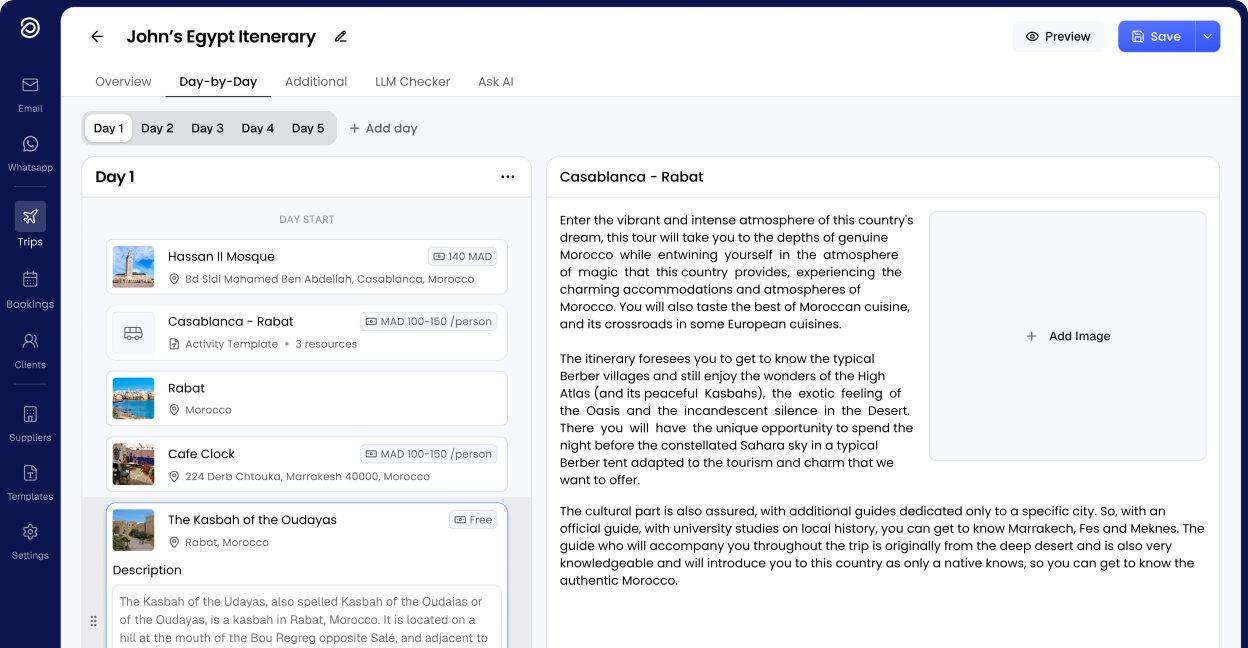
Modern itinerary management software makes this easier by allowing reusable templates within a structured day-by-day system.
The result:
- •Less manual rebuilding
- •Faster client response time
- •More consistent proposals
2. Automate Pricing Calculations Instead of Using Separate Spreadsheets
Pricing recalculation is one of the most error-prone parts of DMC operations.
Common scenarios:
- •Client changes room type
- •Adds an activity
- •Removes a transfer
- •Increases group size
- •Switches season
When pricing lives in Excel separate from your itinerary document, each change requires manual adjustment.
This increases:
- •Risk of margin errors
- •Misquoted totals
- •Time spent double-checking numbers
Practical Tip
Integrate pricing directly into your itinerary structure.
When accommodation, transfers, and activities are connected to cost data, pricing updates automatically as components change.
For DMCs managing multi-day tour planning with multiple suppliers, this reduces manual recalculation significantly.
Even if you don't fully automate everything, centralizing pricing logic in one place is a major operational upgrade.
3. Centralize Communication Around Each Trip
Many DMC teams lose time searching for information across tools:
- •Email inboxes
- •WhatsApp chats
- •Internal Slack messages
- •Separate booking notes
When communication isn't linked to the itinerary record, context gets lost.
This leads to:
- •Re-reading long email threads
- •Asking colleagues for clarification
- •Missing client preferences
- •Delayed responses
Practical Tip
Adopt a workflow where all communication related to a booking is attached to a single trip record.
This might include:
- •Email summaries
- •Internal notes
- •Supplier confirmations
- •Change history
When your inbound tour operator CRM connects communication to the trip, your team spends less time searching and more time acting.
Reducing context-switching alone can significantly reduce manual workload.
4. Create Standard Operating Procedures (SOPs) for Repetitive Tasks
Not all automation is technical.
Sometimes, the most effective way to reduce manual work in DMC operations is to standardize decision-making.
Examples of repetitive tasks that benefit from SOPs:
- •Quotation approval process
- •Supplier confirmation workflow
- •Payment follow-up timing
- •Revision handling process
- •Cancellation handling
Without defined processes, each booking becomes a custom operational exercise.
Practical Tip
Document your repeatable workflows:
- •What happens after proposal acceptance?
- •Who confirms hotels?
- •When do you collect deposits?
- •How do you track unpaid invoices?
Once standardized, many of these steps can later be supported or automated within tour operator software.
Clarity reduces repetition. Process reduces friction.
5. Automate Follow-Ups and Proposal Tracking
One of the most overlooked sources of manual work is follow-up management.
Many DMC teams rely on memory or inbox reminders to:
- •Follow up on sent quotations
- •Check pending confirmations
- •Remind clients about payments
This creates cognitive overload.
And missed follow-ups mean missed bookings.
Practical Tip
Use systems that allow:
- •Proposal status tracking
- •Automated reminders
- •Clear booking stages
- •Internal visibility into pipeline
When your travel agency workflow includes structured deal tracking, you don't need manual reminder systems.
This doesn't remove the personal approach — it simply ensures consistency.
What Happens When Manual Work Is Reduced?
Reducing repetitive tasks in your DMC doesn't mean reducing effort.
It means shifting effort toward:
- •Designing better experiences
- •Strengthening supplier relationships
- •Improving response time
- •Refining product quality
- •Increasing conversion rates
Operational clarity often leads to:
- •Faster proposal turnaround
- •Fewer pricing errors
- •Smoother booking confirmations
- •Less internal back-and-forth
- •Higher team morale
In competitive inbound tourism markets, operational efficiency directly impacts profitability.
A Note on Technology and Automation
Many DMCs hesitate to adopt automation tools because they fear complexity.
The key is not adding more systems. It's replacing fragmented workflows with structured ones.
Modern DMC automation platforms combine:
- •Itinerary management
- •Supplier tracking
- •Integrated pricing
- •Communication linking
- •Proposal generation
- •CRM pipeline visibility
When implemented thoughtfully, the right system reduces manual work without removing flexibility.
DMC Lounge, for example, was built specifically to support structured multi-day itineraries and reduce repetitive operational tasks for inbound tour operators.
But regardless of the tool you choose, the principle remains the same:
Centralize. Standardize. Automate where possible.
Final Thoughts: Manual Work Should Support Experience, Not Replace It
The goal of reducing manual work in your DMC operations isn't to become robotic.
It's to give your team more time to focus on:
- •Personalizing trips
- •Building unique experiences
- •Strengthening client relationships
Repetitive tasks are necessary — but they don't need to consume your day.
By standardizing itinerary structures, integrating pricing, centralizing communication, formalizing processes, and automating follow-ups, your DMC can operate more efficiently without losing the human touch.
And in a business built on experience and trust, that balance matters.